This Week at Liberty October 03, 2011

Hoots, Howls, and Hollers

Bugs fascinate me and have since I was very young.  While totally annoyed as I watch them marching boldly from the window sill, nose to tail, in serious search for some scrumptious scent, I can’t help but observe their steadfast ways.  And, nothing can be much more disconcerting than the scurry of a giant roach as it darts into hiding when the room is suddenly illuminated….eeeew!

And, by sheer numbers, insects just can’t be ignored.  As a youngster, with my early love of nature…and insects are indeed a part of nature….I started a bug collection like any young scientist want-a-be would do.  Poisons and pins to stop them in their tracks and position them in the cigar box became a passion for me.  Now when I think back on it, I was pretty pathetic as a collector.  I read the other day that “At any moment approximately ten quintillion (10,000,000,000,000,000,000) individual insects surround you in the world.”  This startling fact made me keenly aware of how woeful my three cigar boxes were as a collection.

I also grew up during the “bug eyed monster” genre of horror films featuring giant ants or other mutant insects intent on taking over the world.  Now I am reading about bug behaviors that are even more frightening especially if you carry the giant, mutant image very far.  Not only are there social insect communities that are organized and appear to have a political system that works for the benefit of the whole…how unique, but there are also behaviors that are scary in their reality like the female black widow killing her mate or the female mantis ‘chowing down’ (I can hear the crunch.) on her ‘beau’, that when magnified send chills down my spine!

The excerpt that I read (from Sex on Six Legs, by Marlene Zuk) referred to insect’s use of “mind” control.  The emerald cockroach wasp has developed a system (supposedly a form of mind control) to direct the cockroaches to her brood for food.  The jewel wasp has developed a technique that doesn’t stop the roach in its tracks but, by biting the roach strategically on its head, the wasp is able to lead the “zombie-like” roach using a feeler like a leash” to march the unfortunate roach to the hungry little ones.  Now that is a visual to remember.

Lest you think all insects are evil, there are beetles and earwigs (another big eeew for me) that are actually known to care for their young…how sweet!  With insects making up 80 % of all species and with more being identified all of the time, we can hardly dismiss them as bad and uninteresting…..and we definitely should never underestimate them!

This Week at Liberty

Posted by Terry Stevens

The intake total is now at 3078.

The window (and the rescue arrivals) rare really slowing down now, but as previously noted, that’s to be expected this time of year. Orphan care is officially closed now, although we still get the occasional off-schedule fledgling. Now we’re getting to the point where we can move some long term patients outside and even to release some! And to top off the good news, we may have seen the last of the triple digit days for the year! Let’s see what happened last week…

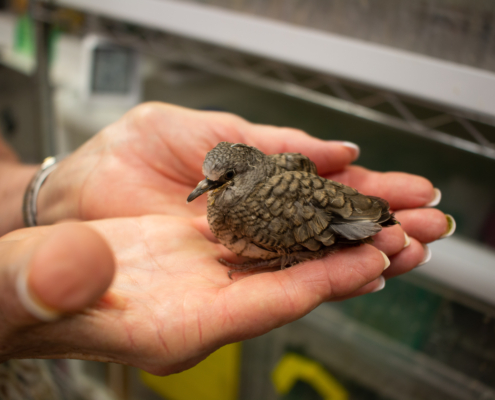
Late juvie inca dove

Jan checks that everything works

A little roadrunner goes outside

Toba checks a young GHO

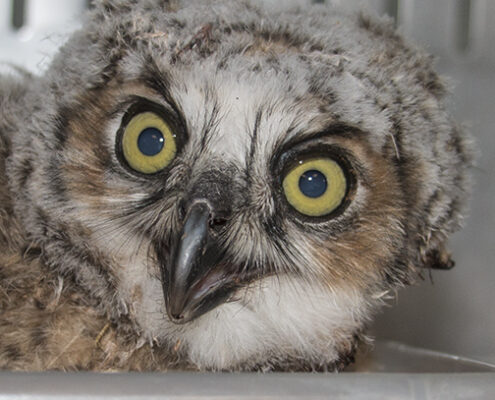
My, what big eyes you have! (for a little GHO)

OK, so even if orphan care is closed, we do still get the stray off-season youngster, like the little inca dove, the youthful roadrunner, and the little GHO.  All appear to be doing OK, and with a little TLC from the Med Services people, they will all soon be outside and on their way to freedom shortly. (Check next month’s Nature News for an article about what effect global climate change is having on animal migration.)

~~~~~~~~~~~~~~~~~~~~~~~~~~~~~~~~~~~~~~

The vet night team suspects a gunshot

Possible GSW in the middle of some bruising

A body wrap is called for

Toba fashions a tail guard for the cooper's hawk

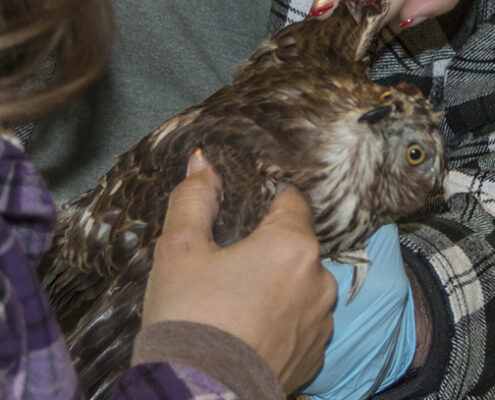
A cooper’s hawk came in last week with some flight impairment. Upon a thorough exam by Jan and the vet night crew, it appears he might have been the victim of a gun shot. A wrap was placed around the wing and body and X-rays are now ordered to confirm the diagnosis. We usually place a tail guard on accipiters since they are prone to damaging their feathers while in captivity, so this little guy got the full treatment so he’ll be ready to release after he heals.

~~~~~~~~~~~~~~~~~~~~~~~~~~~~~~~~~~~~~~

Jan and Sharon check on a burrowing owl

The tiny wing is rewrapped after the exam

Another burrowing owl is in our care with a damaged wing. The break seems to be in a good spot (for a break, that is) and after rewrapping the small wing, he gets to rest up in a brooder for a few more days.

~~~~~~~~~~~~~~~~~~~~~~~~~~~~~~~~~~~~~

Little kestrel gets a shoe

Just to show we don’t only put orthopedic shoes on mockingbirds and doves, the little male kestrel that has been with us for a couple of weeks also got a new shoe last week. DSW called, they want to hire the vet night crew!

~~~~~~~~~~~~~~~~~~~~~~~~~~~~~~~~~~~~~

"Well hello there!"

A misplaced tortoise

Somebody brought in a very nice looking desert tortoise last week. He seems to be in good health and from his size, he has been well fed and is probably someone’s pet that got loose and ran (?) away. He was checked out for health issues, marked with a permanent marker for identification in case his owner shows up to claim him, and transferred to Phoenix Herp for maintenance.

Posted in Uncategorized | 1 Comment

This Week at Liberty September 26, 2011

Hoots, Howls, and Hollers

I am back from Washington, D.C. bearing a gift.  Once again, I am proud to announce that Liberty Wildlife has received recognition for our good work.  We were awarded a “Partners in Conservation Award” by the Secretary of the Interior, Kenneth Salazar.  And, better yet, I got to participate in the ceremony and meet the Secretary.  It ranks up there as a very cool experience for me.

Dr. Tuggle, Megan, and Secretary Salazar

The award was in recognition or our partnership with the U.S. Fish and Wildlife Service, Region 2 and the success of our Non-Eagle Feather Repository. Accompanying me on the trip were representatives from Region 2 including the Regional Director, Dr. Benjamin Tuggle, the Native American Liaison, Joe Early, Michele Gallagher and Robert Mesta.

We were seeped in history at a luncheon held in our honor in the Eisenhower Executive Office Building and surrounded by our fellow conservationists as we received our awards at the Department of the Interior Building.

We were told that the competition was stiff for the award and that only 17 partnerships out of 400 entries made the cut.  Out of the entire country, we were one of these fortunate recipients.  Mr. Salazar stressed the importance of the work of each recipient and the critical need for these kinds of partnering opportunities to help the Department of the Interior complete its mission.  His comments included:

“The Partners in Conservation Awards demonstrate that our nation’s greatest conservation legacies often emerge when agencies and citizens from a wide range of backgrounds come together to address shared challenges,” Secretary Salazar said. “I am pleased to recognize the efforts of dedicated people from across our nation to conserve and restore our treasured landscapes, address water issues and forge solutions to complex natural resource issues through good government and strong partnerships.”

Our Citation ended with “In partnership with the USFWS, the Liberty Wildlife pilot non-eagle feather repository project accomplishes two important DOI goals-it preserves cultural heritage while simultaneously conserving our North American birds.”

And, an extra thrill for me….I got to see close at hand, Beau, the Obama’s Portuguese water dog, as he trotted along the East Wing of the White House on our tour the day after the award ceremony.

It was a trip full of thrills for me!

This Week at Liberty

Posted by Terry Stevens

The intake total is now up to 3053.

As you can see, the intake rate is very low right now, as it usually is this time of year. The updates will most likely cover the other activities that we try to schedule during this yearly lull in rescue and rehab, at least those things that we can actually plan for…! Our annual Birdie Fore Birds golf tournament took place this weekend and seemed to be a big hit with all those who attended, plus we got to release a bunch of birds who have completed the rehabilitation process, and we took in at least one intriguing new patient.  Here’s what happened last week…

Young RTH gets a tag before going "outside"

"I'm likin' this!"

The young RTH who lost his alular (thumb) is now healthy enough to go outside into the flight cage and spend time adapting to this slight limitation to his flying equipment.  Used mainly in high “G” maneuvers and slow flight, he should have little trouble learning to compensate for the loss. We’ll keep you posted.

~~~~~~~~~~~~~~~~~~~~~~~~~~~~~~~~~~~

Burned RTH gets some trimming

We have quite a few electrical injuries at the present time.  This little red tail has been here for a couple of weeks and just now started to slough tissue around his beak. Hopefully it won’t lead to more serious problems. Jan managed to rim the dead tissue and for now, he’s doing OK. Time will tell, as with all electrical burns…

~~~~~~~~~~~~~~~~~~~~~~~~~~~~~~~~~~~

Carol gets ready to release a swainson's hawk (photo by Deborah Downs)

It's a big world out there... Photo by Carol Marshall

Swainson’s hawks are classically migratory – that is, they seem to all decide one day that it’s time to hit the road for Argentina (in the fall) and begin flying in gargantuan groups. Last summer, we got in two birds from the north of Arizona, and one fledgling who was very late for his species.  They went through the rehab process but had missed the migration and had to wait here until it began again.  Last week, the word was out that the swain son’s were moving and Claudia, Deboarh, and Carol took the three “amigos” down to Santa Cruz Flats. They found a large flock of fellow swain son’s who had made a pit-stop at a pecan grove, and released out three who promptly joined the team!  Good luck, guys! We’ll watch for you to pass over in the spring on your way to the midwest!

~~~~~~~~~~~~~~~~~~~~~~~~~~~~~~~~~~~

Carol and Joe give everybody new "Back to school" shoes (jesses)

It takes a lot of tools...!

As the school year begins, all the  education birds are checked for the equipment they will need for another successful education season. This includes general check-ups and getting “new shoes” in the form of anklets and jesses that prevent them from injury when they travel around in their ambassadorial roles. Joe was helped by Jan, Carol, Max, Susie, and Anne as he checked, trimmed, and greased new leather and made new, stronger equipment for the birds.

~~~~~~~~~~~~~~~~~~~~~~~~~~~~~~~~~~

Harley hole...

Steven, Brian, and Morgan performed intern duties at the event.

Ed Le Clere from Chester's officiated at the live auction

Angry birds? What a team!!!

Two of Liberty's finest long-time supporters, Gina Gruenwald and Nancy Coxe, were honored

Double tournament release (two birdies on the same hole!) photo by Allen Spencer

The fifth annual Birdie Fore Birds golf tournament was held last Saturday and by all reports, it was a resounding success. Two HaHa’s were released by Gina Gruenwald and Nancy Coxe who were honored for their continued support of this and all Liberty functions. Many holes were sponsored by local firms and people who care about Arizona’s wildlife, and a great morning/afternoon was had by all who attended.

~~~~~~~~~~~~~~~~~~~~~~~~~~~~~~~~~~

A diamondback on the "disabled list"

OK, so he's not that big, but he still packs a dangerous bite!

Most of the snake calls that come in to Liberty turn out to be the non-venomous variety even though people are SURE it’s a rattle snake! But this little baby diamondback came in from a filling station with some damage to his jaw and fangs (it’s never the tail…sigh.)Dr. Orr will have to anesthetize the little guy and do some of her remarkable micro-surgery and get him back in shape to go and be what he was designed to be. I’ll try to get some photos of the operation…

Posted in Uncategorized | 7 Comments

This Week at Liberty September 19, 2011

Hoots, Howls, and Hollers

I am currently traveling (more on this next week) so I’ll be brief with a feel good story.

A couple of weeks ago, Joe and Jan Miller took Sonora, our four and a half year old bald eagle, to see the crowds at the Verde Canyon Railroad.  As always, they were a big hit.  The Verde Canyon has had a successful eagle season this year.  It is always a thrill for the riders to get to see eagles in the wild, and the train crew is great about pointing them out….what a treat for everyone.

This train ride was exceptional for one family in particular.  Tucked away in one of the cars were a lady and her adoring family who had flown to the Valley from different locales, and do so the same time every year, to celebrate their mother’s birthday.  This year was particularly special….a train ride on the Verde Canyon railroad to celebrate her hundredth birthday ….yes, one hundred years old and enjoying life to the fullest!

She was in a wheel chair which made it a little difficult for her to see everything that was going on.  Realizing this Joe and Jan invited her to a special viewing after she got off of the train.  They carefully set it up so that she could get close to the eagle…eye to eye so to speak and then have her photo taken next to the impressive Sonora.  Joe and Jan regaled her with all of the interesting facts and anecdotes related to Sonora and her fellow bald eagles and spent a goodly amount of time satisfying her voracious interest.

When it was time to go she said the words we love to hear from folks, but it meant so much more from her:  “This was the best birthday of my life!”  All one hundred of them……….all I can say is WOW!

This Week at Liberty

Posted by Terry Stevens

The intake total is now at 3029.

The rate of arrivals is dropping, as is normal for this time of year. Last Monday we took in two birds all day, then on Tuesday afternoon, four came in an hour! And, although the Orphan Care center is nearly closed for the season, we still have tiny babies coming in. Plus, we received a couple of not-so-normal visitors again. Take a look and read on…

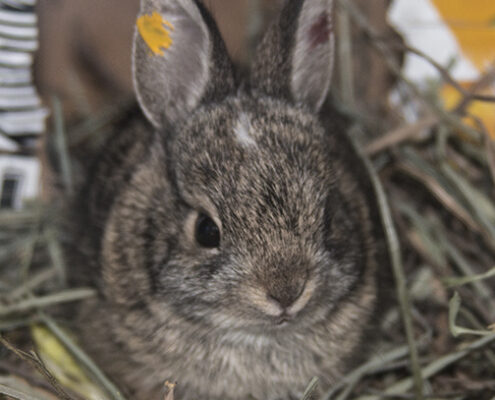
Ahhh, the bunnies are still at it...

...as are the inca doves, obviously

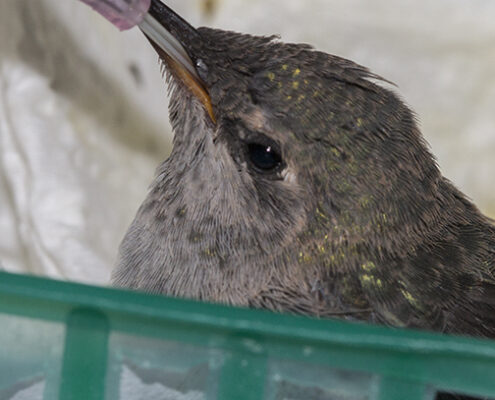
Tube feeding the baby inca.

OK, the OC center is rapidly being cleaned up, the brooders and incubators are being put away until next spring, and still there are tiny babies showing up at the window. The bunnies, well, are still bunnies so you might expect them to breed all year, but the newly hatched inca dove was a bit of a surprise. The feeding tubes will be out for a few more weeks…

~~~~~~~~~~~~~~~~~~~~~~~~~~~~~~

Dave brings in an injured GBH

Another injured wader - a black necked stilt comes in.

Wading birds can get into trouble any time of the year. Dave Kendall rescued and brought in a great blue heron with a disastrous broken leg from a local golf course and a little black necked stilt with injuries from an undetermined source.

~~~~~~~~~~~~~~~~~~~~~~~~~~~~~~

This thrasher was attacked by a dog

The injuries this curved-bill thrasher sustained were from an all too determined source – the family dog. Birds that forage on or near the ground are particularly susceptible to attacks from household pets. Luckily, this little guy was rescued before the damage was life-threatening.

~~~~~~~~~~~~~~~~~~~~~~~~~~~~~~

Mockingbird shows off his Jimmy Choo's

One of the last inmates of the OC area is this mockingbird who has deformed feet. Once again, the Med Services staff fashioned some orthopedic “shoes” for him and hopefully his toes will point in the correct direction when he’s done.

~~~~~~~~~~~~~~~~~~~~~~~~~~~~~~

Sharon and Toba examine a turkey vulture

Another bird that showed up during “Vet Night” last week was this TV from the lower west side (you know, near all those land fills?) Presenting only a somewhat loose shoulder, his wing was wrapped and he is undergoing cage rest at this point.

~~~~~~~~~~~~~~~~~~~~~~~~~~~~~~

A BuOw gets checked

It's a wrap...!

"Does this wrap make me look fat?"

AAnother Vet Night arrival was this little burrowing owl. Presenting what appears to be a fractured upper wing, he was wrapped by Toba and Sharon, given some Dex, and placed on cage rest. Hopefully he will become one of the “Instructor owls” for some of our many orphan BuOw’s.

~~~~~~~~~~~~~~~~~~~~~~~~~~~~~~

An injured sora rail arrives

Gorgeous plumage...

A not very frequent visitor to the facility is this sora rail. Presenting symptoms of a fairly serious head trauma, this little guy is in the ICU and will be watched carefully over the near future. A particularly beautiful example of a particularly beautiful bird, AZG&FD has an interest in saving this bird. Fingers crossed, please!

Posted in Uncategorized | 1 Comment

This Week at Liberty September 12, 2011

Hoots, Howls, and Hollers

This is one of those strange times of year.  I don’t want to keep harping on the heat, but it was beginning to cause unpredictable issues.  Here’s the deal.

We have lots of babies that are in different stages of readiness to be released.  They have been raised with foster parents. They have been in with trainer adults.  They have been allowed to take live prey (not my favorite time of the year, but a necessity!).  And, they have been readied to fly free.  The weather hasn’t cooperated…..until now!

One day following another of intensive heat warnings made it very difficult to send these youngsters on their ways. So, they remained in the flight cages getting stronger and readier, but taking up badly needed enclosure space.  We have three young Swainson’s hawks that need to make their long journey south and the migration is happening now.  They will have to be readied for release before they miss the migration so we find ourselves doubly thankful for this respite of cooler weather.  This week has seen boxes of birds leaving the facility on their way to freedom, driven to selected release sites by many excited volunteers who have helped in this process.  What a great reward it is to see these patients go from “helpless” to “I’m so out’ta here!”

And, there is further proof that the migration is here.  It seemed that last week we got the message loud and clear ……migration of song birds.  In a manner of hours, we received the following birds that were stopped in their journey (hopefully only briefly) to reach suitable climes for making a living through the winter months: a MacGillivary’s warbler, a yellow warbler, a western tanager, a green tailed towhee, and a black headed grosbeak….that kind of admittance at the intake window all before noon on one day only happens during migration and somehow our window appears to be on the path!  Well, some of them had help getting to the window, but there is a definite indication that the migrants are on the move.

Watch for these jewels at your feeders and in your neighborhood…a glimpse of one of these rare visitors could make your day!

This Week at Liberty

Posted by Terry Stevens

The intake total is now at 2992.

OK, we didn’t really take last week off, we just had a bunch of other deadlines to make and since it coincided with the holiday, it made sense to slide a week. But we’re back, so here it goes!  In addition to getting in a northern goshawk, a special sparrow arrived, and we made another trip to Bark Avenue to get some much needed X-rays done. Some of the news was good, some maybe not so much, but the work continues…

Pikachu...with large talons!

Max holds Phoenix for Jan

One aspect of maintaining raptors (especially eagles) in captivity is controlling the growth of their beaks and talons. Normally, this function is handled by the natural wearing process that takes place as the bird eats and cleans itself during everyday activity. Since they no longer have to work so hard, beaks and talons tend to become overgrown which can cause serious problems in terms of overall health. Every now and then, these large birds have to be brought in to have their talons trimmed and their beaks “coped” by skilled medical services people. Last week, it was time to bring Phoenix in for  a routine beak adjustment and ‘pedicure’ procedure. (The only towel available that was big enough to hold him was a Pokeman Pikachu style, donated to Liberty from a local family!)

~~~~~~~~~~~~~~~~~~~~~~~~~~~~~~

Visiting lark sparrow

There are three species of birds that are commonly found in the local area that are not considered natives: pigeons, starlings, and sparrows – but in fact, only the european sparrow is the true alien. there are several sparrow varieties that are native to both North America and Arizona, one of which is the lark sparrow. We took in one of these LBB’s (little brown birds) a few weeks ago, kept him until he was healthy, and last week he got released to rejoin the wild population.

~~~~~~~~~~~~~~~~~~~~~~~~~~~~~~

Beautiful northern goshawk

We don’t get to see goshawk’s too often as they live in cooler forested areas normally, so when word came down that one had been injured up near Pine Top, Peggy was happy to provide transportation for the big girl down to Liberty. Having survived one surgery up north, X-rays provided much needed information as to the extent of her damage.

~~~~~~~~~~~~~~~~~~~~~~~~~~~~~~

Another glue trap targets our state bird!

Jan and Art work carefully to free him

Finally unstuck!

I won’t waste time saying it again…oh yes I will – GLUE TRAPS ARE NOT A GOOD THING!! Just like broadcasting a non-species specific poison to target one species, sticky traps cannot exclude creatures that are caught unintentionally in the glue. These devices are like drift nets in the ocean which actually trap and kill many more “by-catch” species than they are supposed to target. This cactus wren got stuck, lost many feathers, and broke his leg on a trap set out to catch scorpions. Ironically, he probably would have eaten more scorpions than would have been caught in the trap.

~~~~~~~~~~~~~~~~~~~~~~~~~~~~~~

Dr. Wyman checks a wing wrap

Sharon has a new friend

Tuesday afternoon is usually set up for “vet night” when all the animals in the ICU are checked individually by the senior Med Services volunteer or Jan, our Animal Care Coordinator. Sometimes Dr. Wyman is on hand to assist in this process which helps the staff as they check the rehabilitation status of the birds and other animals in our care. The system works well as everybody gets a thorough exam and evaluation as to their progress and prognosis.

~~~~~~~~~~~~~~~~~~~~~~~~~~~~~~

Will it work?

Dr. Orr checks on an RTH who lost an alular

Zone tail gets an X-ray

Three pellets are found...

Dr. Orr checks the goshawk's wings

The little golden is examined

Why it's called "bendy bone"

Dr. Orr is now working at Bark Avenue in Mesa (a wonderful place to take you pets for vet service!) and this gives us an occasional opportunity to get X-rays of animals and birds who need this service. Last week, an RTH, a HaHa, a zone-tailed hawk, the little golden eagle, and the goshawk were taken there for X-radiology. Sometimes things show up that were not totally expected, such as the three pellets found in the zone tail’s wings and body. Other times, this confirms what was deduced through external exam, such as the folding fracture damage to the golden’s legs and rib cage. The goshawk’s X-rays showed that she indeed had a broken wing on the opposite side as the patagial damage.

Posted in Uncategorized | 4 Comments

This Week at Liberty September 5, 2011

Although the animals Liberty works with never get a day off, HHH and TW@L are observing the Labor Day holiday with a break.
See you all next week with a new update.

Posted in Uncategorized | Leave a comment

This Week at Liberty August 29, 2011

Hoots, Howls, and Hollers

Record highs, record high lows, extensive heat warnings, most continuous days over 110, and let’s not forget the haboob….what a summer!  For the most part we humans can hunker down in our air conditioning…cars, malls, homes, offices.  But, what strategies do our wildlife neighbors use to survive these extremes?

Extremes are a challenge for every living thing….even well adapted wildlife.  At Liberty Wildlife we are seeing strange patterns of late nesting Inca doves, premature fledging of young Harris’s hawks diving out of sun stressed nests or high numbers of first year animals who are just not making it.

So, what are some of the techniques used by these animals that do survive these conditions?  Adaptations basically fall into two categories, physical and behavioral.

In the desert, scant water supplies and extremely high temperatures have to be dealt with often for long periods of time.  Water can be taken in solely from the food or prey eaten by native animals or from eating succulent plants including cactus when there is no standing sources.  Some can convert moisture from their breath into water that is consumed and some animals like kangaroo rats don’t consume free water at all but convert it metabolically through the seeds that they eat.

The need to cool down heated bodies is also an issue desert animals face.  Jack rabbits, for example, have tall erect ears that provide an almost hairless space for blood to be close to the surface allowing the breeze to flow over it sending the cooled blood throughout the rest of the body cooling the body as it goes.  My favorite, used by the turkey vulture is called urohydrosis…yep, the turkey vulture urinates on its bare legs, the wind blows over the then wet legs, cools the blood, the blood flows through the rest of the body, cooling it as it goes…nifty, huh!  Birds also excrete urates forcing waste out of the body using precious little water in the process.  Because coyotes and owls gave up sweat glands to have hair and feathers, they must pant in the case of the coyote or gular flutter in the case of an owl, cooling the blood that will then flow through the rest of the animal’s body.  Some animals in the desert are paler in color than their kin folk in other parts of the world allowing for less absorption of the sun’s rays…thus less heat.

Behavioral activities are also critical to survival of desert animals.  Ground squirrels making a daytime living on the surface of the desert will run down deep into their burrows and flatten their stomachs to the ground dumping the heat and allowing the blood to cool that way.  Some birds like the phainopepla and some hummingbirds will migrate to cooler areas after their early nesting season in order to avoid the increasing high temperatures of the late summer.  Estivation and hibernation are used by some ground squirrels and similar animals to sleep away the extreme times.  Crepuscular activity (hunting during the dusk and dawn) or total nocturnal behaviors become the saving grace of many animals like owls and reptiles which is why they are so seldom seen and how they are able to beat the heat.

Humans could probably take some hints from our clever and adaptive wildlife brothers, but I would encourage you not to hope for long erect ears or urohydrosis as options…Go crepuscular; you will fit into our community a bit more easily.

This Week at Liberty

Posted by Terry Stevens

The intake total now stands at 2894.

Obviously the intake rate is dropping off. We are seeing some migrants passing through, thus the first little bird you’ll see tonight.  Otherwise, this is going to be the “Burrowing Owl” special edition of TW@L. A lot of the details have been ‘redacted’ to protect the site locations and the companies involved, so just pretend it’s a CIA report. We also participated in an educational event at Chester’s Harley Davidson in Mesa. The motorcyclists are big supporters of Liberty – especially our eagles!

Pretty Lucy's warbler

Another not-to-frequent visitor to Liberty was in our care last week.  ”Found on the ground”, this Lucy’s warbler was in the orphan care area being fed and examined prior to its release.

~~~~~~~~~~~~~~~~~~~~~~~~~~~~~~

Kids learn about Arizona wildlife at Chester's

Liberty educators are good teachers

Since Chester’s Harley-Davidson has been one of the sponsors for our Born 2 BE Wild motorcycle runs, we have been doing educational programs at their facility in Mesa. Last Saturday, despite temperatures around 114, we introduced more citizens to some of the spectacular wildlife in our state.

~~~~~~~~~~~~~~~~~~~~~~~~~~~~~~

A few months ago, Liberty was asked to help mitigate the possible environmental impact of a very large solar energy plant being build in Arizona. Over the next few weeks, teams from the Research and Conservation team went to the site and retrieved a number of burrowing owls ranging in age from eggs to fledglings. These individuals were brought to Liberty and either incubated (in the case of the eggs) or brooded and are now being maintained at the facility until October at which time they will be released into controlled  colonies at two undisclosed sites (no, Dick Cheney is NOT involved…) Last Monday, these man-made burrows were installed prior to the owls arrival. (all photos taken by Tony Sola)

The materials are brought to the site

The plans are laid...

The construction team (Jan, Nina, Stevie, and Tony) met with the solar company crew at 0600. It was already in the upper 90′s and eventually reached 115!

Digging begins early

Jan and Nina work with the contractor

The 'tunnels' are trimmed for a perfect fit

The plastic buckets and tubes provide a very sturdy alternative burrow and are easily trimmed to fit in exact locations as determined by the biologists.

A completed structure

The “Standard model” provides a living space with two means of ingress and egress for the inhabitants.

Burying a burrow (is that redundant?)

"Finished landscaping to suit..."

Each entry/escape tunnel is landscaped to be readily seen by the owls, yet easily decorated by the future owners to suit their own tastes and needs.

A second site is chosen

A BuOw duplex!

Two sites were used for variety and for security. Some of the “Alternate burrows” were built as multi-family or at least multi-offspring varieties to offer the birds some choices in their new accommodations. Every effort was made to make the new burrows both safe and inviting for the birds. The areas around the ABS homes will now be fenced to protect the owls after they are introduced in October. The fences will eventually be removed and the owls left to live in their new habitats.

Posted in Uncategorized | 7 Comments

This Week at Liberty August 22, 2011

Hoots, Howls, and Hollers

by guest blogger, Andrea Sobotka

Liberty Wildlife Soars into the Social Media World!

In a world that has been shrunk to the touch of a smart phone screen by the genius of the internet, Social Media has become almost a new “realm” to exist on. We thought it was time to Introduce Liberty Wildlife to the community at large…and the whole world! There are so many great stories, events, moments, dramatic rescues, small wins, large wins, and tender moments between the people and wildlife here at Liberty Wildlife, that we thought it was time to develop a platform that allows us to keep you in the loop and up to the minute on what’s going on. Social Media gives a voice to the many and few; we have some interesting voices at our end that itch to be heard, and in turn, we’d like to hear from you.

Since quietly launching our brand new Liberty Wildlife non profit business page on Facebook a couple of weeks ago, we have already had some wonderful interactions and have been steadily gathering some great “Likes” and “Friends”. We have posted some precious pictures from our Orphan Care department, shared some dramatic snapshots and stories from Rescue Transport, and sent out invitations to upcoming fundraiser events. We even posted an urgent announcement that we were in need of a new fridge/freezer and a Facebook friend responded and came to the rescue immediately and donated one! We couldn’t be more grateful for your care and interest in helping us help our native wildlife.

If you are one of the millions of people that connect on Facebook and Twitter, the Social Media Team at Liberty Wildlife cordially invites you to connect with Liberty through a few special page choices on Facebook and Twitter.  Here are the page choices and links for you to explore:

Liberty Wildlife Non Profit Business Pagehttp://www.facebook.com/liberty.wildlife click on the link and “LIKE” us! This is our official central ‘hub’ open to the public to like and interact about all things Liberty.

Lady Liberty Personal Page http://www.facebook.com/ladyliberty.eagle you can send Lady Liberty a friend request. Lady Liberty is the voice of Libby, our leading education bird and Bald Eagle resident elder.

Baby Liberty Personal Page http://www.facebook.com/lwildlife.baby you can send Baby Liberty a friend request if you’d like to connect with our Orphan Care and critter youngsters.

Liberty Wildlife on Twitter – http://www.twitter.com/LibertyWildlife we love to “tweet” and be “re-tweeted”!

I am honored to have been asked by Megan Mosby to head up the Social Media project and Team for Liberty Wildlife. The people and critters here are very near and dear to me, and it is my personal desire to share with the world what a professional, awesome and dedicated organization Liberty Wildlife is. Thank you Megan, et al, for this rewarding opportunity to help introduce Liberty to the world!

On behalf of the Social Media Team and everyone here at Liberty Wildlife, we look forward to CONNECTING with you soon.

Big Hugs,

Andrea Sobotka,

Volunteer

~~~~~~~~~~~~~~~~~~~~~~~~~~~~~~

This Week at Liberty

Posted by Terry Stevens

The intake for the year is now at 2850

The update is a bit short this week, but then things are tapering off ever-so-slightly in the arrival area. A couple of birds that were brought in were actually confiscated by AZG&FD and USFW from people who had them illegally, and we had some more incidents of electrical injuries that need our special care. Plus, it’s still very HOT, and now the humidity is becoming a factor as well. I suppose the monsoons are still a welcome addition to our weather patterns, as long as we live in the desert…

A "zoned tail"!

The big female zone-tailed hawk is doing fairly well despite her injuries. I’ve heard a lot of folks say they have never seen or even heard of the zone-tail so I’m including this shot to illustrate the reason it’s called the “Zone-tail.”

~~~~~~~~~~~~~~~~~~~~~~~~~~~~~~

Evidence of burns

One of the many red tails we get in was examined by Jan last Tuesday and it was discovered that he quite possibly had some electrical burns.  When his damaged feathers were pulled, the ends appeared to have been singed and showed evidence of burning. This is just one way the sleuths of “CSI – Liberty Wildlife” can determine which birds have come in contact with electricity in a negative way.

~~~~~~~~~~~~~~~~~~~~~~~~~~~~~~

Burned RTH

Nina and Rebecca give fluids

Flash damaged tail feathers

This RTH came from the Globe area where he was being ‘treated’ by an unlicensed individual for what turned out to be electrical burns. His feet and most of his feathers sustained significant damage in an apparent explosion of a piece of power equipment. When I helped extract him from the rescue carrier, he looked very light in color.  We figured it was because the tips of most of his feathers (which contain the color) were burned off in the flash. His tail feathers are mainly quills with a lot of the vanes destroyed. The man had been holding him for two weeks, feeding him beef and water. If no further damage is found, he will be with us for several months as his feathers grow back in.

~~~~~~~~~~~~~~~~~~~~~~~~~~~~~~

Lots of new feathers for this HaHa

Jan checks for canker

And still the babies/fledglings come in.  This little HaHa was brought in recently, just beginning to produce juvenile feathers on his wings, tail, and body. The blood feathers are distinctive and grow rapidly as he develops. Currently, he is in with Sequoia, our harris’ hawk foster mom.

~~~~~~~~~~~~~~~~~~~~~~~~~~~~~~

Jan having an eye-to-eye with a GHO

There are always arrivals with injuries of unknown origin, and they all get the same stellar treatment from the medical team. The next step is moving “outside” as they progress in the rehabilitation process. Sometimes, a close face-to-face exam is in order, one of which produced this photo of Jan examining one of the many GHO’s in our care.

~~~~~~~~~~~~~~~~~~~~~~~~~~~~~~

Barn owl soup...

It was so hot and sticky last week that Henri(etta) thought she’d take a moment to cool off in her water tub. Many birds enjoy a dip like this as the water on the unfeathered portion of their legs and feet aids in the overall cooling of the blood as it flows through the legs.

Posted in Uncategorized | 3 Comments

This Week at Liberty August 15, 2011

Hoots, Howls, and Hollers

Every so often we get in an animal that’s uniqueness sends me to the books.  We don’t get many yellow billed cuckoos and never in my memory have we gotten a baby.  What sent me to researching was the statement by the biologists who brought it in to us.  They are studying the cuckoo which is pretty rare in the west and is actually declining in the southeast, its most normal range.  They had been studying a nest and found it destroyed (they aren’t too impressive to begin with), two of the nestlings were dead and the third one, while still alive, seemed stunted.

What we learned from them was that nestlings begin to crawl around the branches when they are as young as 7-9 days old in search of insects and in particular caterpillars…the hairy kind…While that was interesting, the other thing I learned was that the feathers of babies, at about 7-9 days old, burst out of their sheaths all at one time over about a two hour period of time.  Unbelievable!  If you have ever watched a baby bird develop you have seen the slow methodical process of the feathers coming in slowly but surely, some parts of the bird’s body ahead of the others, and it goes on for a differing number of days, downy to hard pinned, depending on the species.  I am now obsessed with seeing this happen.  It is unlikely that I will ever have the opportunity…so it will fester in my imagination unsatisfied.

There is another interesting and unique characteristic about this bird.  Their eyes are wide set on their heads and with that arrangement they are able to focus in both the front and rear.  This is a helpful adaptation that serves their behavior of standing very still hidden in the leaves of a tree watching and patiently waiting for prey, a caterpillar, an army ant, an unsuspecting beetle.  If they had to continually scan the environment to protect from getting jumped from behind by a local thug, they wouldn’t be able to consume the amount of food they are known to take in.  One study showed the stomach contents of a yellow billed cuckoo to be 325 hairy caterpillars in one day and another that took 41 caterpillars in 15 minutes….now that is impressive!

This factoid is confirmed by the Orphan Care volunteers who are charged with feeding this little guy all day long.  The instruction is to supply him with meal worms, wax worms, etc. every time he gapes, and it appears to gape every time the brooder is open.  No wonder they have adapted to take on some of the feeding activities at such an early age.  No self respecting parent could feed itself and three little babies and live to tell about it without this helpful adaptation.

Until I read about this voracious need to eat, I was judging them as suspect parents when I read that they sometimes laid their eggs in another bird’s nest….but considering the eating needs, the benefits in this adaptation became apparent too.

And, I still can’t get past the feathers bursting out of the sheaths in a two hour period of time!

While you ponder this, ponder also the wondrous notion that Liberty Wildlife is getting ready to leap, really leap, into the world of social media.  Watch for Lady Liberty and Baby Liberty to launch as two Facebook pages for you to ‘friend’ and for the Liberty Wildlife business page to grace the ethers. You can rush to ‘like’ us!  Then there will be something to Tweet about….yep that’s out there too.  There is much to ponder until next week and more to come.

This Week at Liberty

Posted by Terry Stevens

The intake total for the year is now at 2786. This was a fairly busy week, for lots of reasons, not the least of which was the transport of the initial 8 pelicans from Liberty to Sea World San Diego. More on that below. We also were pleased that a lot of patients made the big step in moving from their enclosures inside the ICU to new habitats outdoors in the compound, always a good sign of progress! Plus, we took in a couple of different, intriguing animals, so press on…

Baby king snake gets stuck! (photo by Susie Vaught)

An unlucky (or very lucky, depending on your point of view…) little baby king snake was brought in last week.  He had gotten trapped on a sheet of our perennial nemesis, glue trap paper. Not big or strong enough to pull himself free of the sticky coating, he was hopelessly trapped. The volunteers in the ICU gently washed the gooey substance off of him and finally he was free. A few hours of observation is hopefully all he’ll need before he goes free to tell his friends to stay off the glue! ~~~~~~~~~~~~~~~~~~~~~~~~~~~~~~~~~~~~~~~~~

Another Zone tailed hawk comes in  (photo by Susie Vaught)

A wing wrap is placed in position  (photo by Susie Vaught)

An uncommon visitor to the valley is this zone-tailed hawk.  We have only gotten in a few in the 30 year history of Liberty, one (Rio) currently a resident in the Education collection. This bird was rescued by Daily Care Team Lead Claudia Kirscher on the west side with wing injuries of undetermined origin. She is doing fairly well and although the break is fairly bad, her prognosis is somewhat optimistic. ~~~~~~~~~~~~~~~~~~~~~~~~~~~~~~~~~~~~~~~~~~~~~~~~~~~

A young RTH is checked  (photo by Susie Vaught)

A GHO is given an ID band (photo by Susie Vaught)

Kestrel gets his wing wrapped  (photo by Susie Vaught)

Screech owl goes outside  (photo by Susie Vaught)

Feeding the yellow-billed cuckoo

Barn owl amputee is doing well!  (photo by Susie Vaught)

Jan was extremely pleased at vet night last week as several birds were well enough to go “outside” which meant that cages in the ICU were open for new arrivals – and the birds who made the move were that much closer to being free or placed, depending on their ultimate stays. The young RTH, the GHO with the large ear tufts, the screech owl, and the kestrel all made the move, as did the barn owl with the partial wing amputation.  He (or she!) will have their gender positively determined and then be placed with another facility looking for breeding barn owls. It was a good week for a lot of birds! ~~~~~~~~~~~~~~~~~~~~~~~~~~~~~~~~~~~~~~~~~~~~~~~~~~

Awaiting their flight home

The carriers are ready

At plane side, thanks to US Airways!

In good hands

“Now boarding all pelicans!”

Ready for push back

Last Tuesday morning, Craig Fischer and I loaded 8 brown pelicans into four containers and with the help of Tony Sola, drove them to Sky Harbor airport for the journey home. Once again, US Airways proved to be a friend to Liberty and Arizona Wildlife by providing air transportation for these wayward flyers from their temporary home at Liberty to Sea World San Diego where they will be given their final exams and released back to the wild (except for the one little guy who lost part of his wing.) If you missed the story in the Republic, click here:
www.azcentral.com/pelicans

~~~~~~~~~~~~~~~~~  BUT WAIT!!!  ~~~~~~~~~~~~~~~~

There’s another one! (photo by Tony Sola)

Last Saturday, Tony Sola drove to Ocotillo Golf Resort where the manager, Mr. Mark Gurnow had called about this pelican.  It seems he read the Republic story and learned that brown pelicans need to live near salt water.  As it turns out, the bird has some small eye issues and is supporting a parasite overload.  He is otherwise healthy and will make a similar flight this week!

Posted in Uncategorized | 3 Comments

This Week at Liberty August 8, 2011

Hoots, Howls, and Hollers

We plug along, doing what we do as well as we can do it….with integrity, perseverance and dedication.  We ready animals for release back into the wild whenever possible.  The magical moment when we let an animal go, is almost always with “a prayer” and the hope that we will never have to see the animal again….in rehab that is.  We don’t band everything anymore for a lot of reasons, and it is only high profile and scientifically critical animals that get banded and radioed with telemetry….such as bald eagles.  This banding provides us with information that helps us all learn how to do what we do better.

Occasionally we get results of animals that have been found years later that were banded and the band traced to time at Liberty Wildlife. We are always interested to see where they ended up, how long they survived in a tough world, and any other information that can be garnered from their situation.

And then there are times when we just want to celebrate.  This recent e mail was sent to us by Kyle McCarty, Bald Eagle Field Projects Coordinator for the AZ Game and Fish Department.  Its subject line was “One for the win column”.  Please read the note below and celebrate a success with us.  I remember this release, the photographs that Terry Stevens took of the eagle skimming the lake leaving it’s reflection in the water as a final goodbye, most likely fleeing our cheers from the shore.  How cool that he is alive and well and entertaining folks in Mesa.  Apparently his hard wiring for hunting kicked in, and he is one of the low percentages that make it to adulthood!

I feel elated.

2007

“While going through some photos from this year’s bald eagle season, I noticed that we received a photo from the public of a near-adult bald eagle at a retirement community in Mesa this past January. In 2007, this bird (blue band 21 over C) was an eagle that had just fledged from Needle Rock breeding area on the lower Verde River and was rescued and taken to Liberty Wildlife on May 20, 2007, apparently for elevated liver enzymes (?). We released it during a media event at Roosevelt Lake on December 6, 2007. With help from Liberty we had placed a tail-mounted radio transmitter on this bird in order to track it after release and it disappeared I think about a week later. Forest Service helped with tracking.

This is one of those rare cases where we learn the fate of a young/fledgling bird that had no hunting experience in the wild prior to being released. Thanks to Liberty’s care we get to put this one in the ‘win’ column.”

This Week at Liberty

Posted by Terry Stevens

The intake total is now at 2700.

Well, believe it or not, things are slowing down – just a little! The rate buzzer sounds at the window and the “tingle” each time the hotline phone rings is incrementally smaller each week now, so we can tell we are s-l-o-w-l-y approaching the end of the baby bird season for 2011. BUT, we’re not out of the woods yet, and this post will be  a little short as I have to prepare for shipping 8 pelicans to Sea World tomorrow morning!

But, we’re still getting in babies of all types and some old patients are still in our care, so let’s press on with this week’s update…

Baby bunny gets a drink

OK, I’ve said it before: rabbits breed like – rabbits! We’re still getting in newly borne cottontails so the brooders will stay busy for a while.  Some of the little guys don’t like the formula they get, but they al seem hungry enough so eventually they all eat. Still, if cuteness were marketable, we’d be the richest outfit in the valley!

~~~~~~~~~~~~~~~~~~~~~~~~~~~~~~~~~~~~~~~~~~~~~~~~

Baby night hawks growing up

The baby night hawks are growing rapidly and are also high on the “cuteness” scale. These little gapers enjoy the meal worms and attention they get and hopefully will soon be out and devouring mosquitos by the ton!

~~~~~~~~~~~~~~~~~~~~~~~~~~~~~~~~~~~~~~~~~~~

Fledgling ash-throated flycatcher

Another not-so-usual visitor to the orphan care area is this ash-throated flycatcher. The bird seems happy to be in such good care and the wonderful Orphan Care volunteers are thrilled to have something out of the ordinary to feed and care for.

~~~~~~~~~~~~~~~~~~~~~~~~~~~~~~~~~~~~~~~~~~~~~~~

Two young muscovy-mix ducks

OK, I have to keep saying, WE DON’T TAKE IN NON-NATIVES, but we also don’t turn anything away out of hand.  These little muscovy mix ducks found their way to us and have already been placed with a local person who will maintain them as they grow older. (When we found out they are supreme fly catchers, it was suggested we keep them at Liberty, but since our neighbors – the HaHa family – might find them irresistible, we thought better of it!) They will be joining AFLAC the duck in leaving the facility shortly.

~~~~~~~~~~~~~~~~~~~~~~~~~~~~~~~~~~~~~~~~~~~~~~~

An injured GHO is examined

Dr. Wyman checks another owl wing for progress

Even though we got in some interesting visitors lately, we still deal primarily with the usual suspects, RTH’s, GHO’s, and HaHa’s.  Two little GHO patients got examined by Jan, Dr.Wyman, Toba, Sharon, and the rest of the Tuesday ‘Vet Night’ squad last week.

~~~~~~~~~~~~~~~~~~~~~~~~~~~~~~~~~~~~~~~~~~

Tri-colored wrap for a haha

New blood feathers coming in

HaHa gets a beak trimming

We seem to have our usual plethora of harris’ hawk patients this summer. Electrical injuries appear to top the charts, with auto collisions and general emaciation rounding out the top three reasons we see HaHa’s. The bird that had the tip of one wing amputated is already growing new feathers on the site of the amputation – a good sign! And the bird with the Schroeder-Thomas splint also appears to be improving and has been given a less “exotic” apparatus to hold his mending leg in place.

~~~~~~~~~~~~~~~~~~~~~~~~~~~~~~~~~~~~~~~~~~~~

A common view of a least bittern

So when I said that the least bittern we got in recently was a rare occurrence, What I really meant to say was that it’s usually rare – is that an oxymoron or what?  So, as luck would have it, we got in another one this week! Like his cousin, this one was mostly uninjured, but just happened to find himself in an inappropriate spot. After a little fattening up, he too will be released in better surroundings. (This picture shows their “I’m not a bird – I’m a reed!” pose in which they point their beaks skyward and watch for threats with those downward looking eyes while trying to blend in with their riparian shoreline habitat!)

Posted in Uncategorized | 1 Comment

This Week at Liberty August 1, 2011

Hoots, Howls, and Hollers

I recently read a review of a controversial book, Weeds, In Defense of Nature’s Most Unloved Plants, by nature writer, Richard Mabey.  My biologist and conservation friends should start getting uneasy about now.  It made me ask some questions that aren’t very popular in the conservation world.

He defines weeds as plants that occur in the wrong place at the wrong time.  So far so good…He made the following case in favor of weeds:  they have basic usefulness for stabilizing the soil, curbing water loss, providing shelter for other plants, repairing landscapes shattered by landslides, fires, floods, and development.  They serve as food, fuel, medicine, dyes, building material for insects and birds, and certainly weed pulling builds character.  And, most of the weeds are the consequence of the activities of humans and civilization.

His ending argument is that we find ourselves in a time of great environmental changes and as a result weeds might be all we have. Ultimately we should learn to tolerate them (my note: except for bufflegrass) and their resilience…changing our perspective because they are basically here to stay.  Ok, say what you will, that is his case in a nutshell. He does, however, continue to weed his garden.

Here’s where I started asking the unpopular questions.  It has been politically correct for the conservation world, which I consider myself a part, to discourage all non-native wildlife.  It bumps native animals out of habitat, nesting areas, food and causes havoc for the native fauna.  But if Mabey’s argument for weeds was used for wildlife, what would it look like?

If starlings, sparrows, or love birds became prey items that Cooper’s hawks recognized as potential food, would the Inca dove or masked bob white numbers begin to revive?  Would other threatened predators increase in numbers if an increase in non-natives provided an alternative to native birds as prey?  Roadrunners have learned to make a meal out of a tasty English sparrow sparing other non-natives.  Gopher snakes don’t turn their noses up at a squab or two if they are available…bad news to the pigeon nesting in his turf.  Non-native birds can help pollinate, spread seeds, perform the same duties as native birds…so maybe they aren’t all bad….maybe?

Ok, now have I angered all of my friends?  I am not saying that I agree with Mr. Mabey’s assessment, but I am just asking questions.  Like, how long does a non native weed, bird, turtle, reptile, or fish, have to be in an area before it is considered part of the acceptable neighbors in the hood?  I’m just asking….after all my relatives moved to America from Scotland, Ireland and Germany in the formative days of our country, and I am certainly not Native American….am I still a non-native? It’s been a long time.

How long does it take, and what do I have to do?  I am just asking.  And, I expect to get answers.

This Week at Liberty

Posted by Terry Stevens

The intake total for the year is now at 2601. A lot of activity lasy week as we saw some real improvement in some of our longer-term patients, and we continue to work on providing the best care for the orphans in our care. We also took four birds to the Eye Care For Animals clinic in Scottsdale for evaluation of their eye problems. We also had a great release story, thanks to volunteer Holly Hicks and Arizona Game and Fish.  Read on…

Clark's spiny lizard in his terrarium

The clark’s spiny lizard that came in a couple of weeks ago after a dog attack is doing better each day. Near death upon arrival, he was treated by the Med Services team and is now up and about and hunting crickets (inside his terrarium) on his own. ~~~~~~~~~~~~~~~~~~~~~~~~~~~~~~~~~~~~~~~

New bunny hutch

Introduction to their future environment

We are constantly striving to provide the most natural environment for our orphans in order to better prepare them for eventual release.  We now have a new, hich-tech brooder for our smaller orphan bunnies which provides them with temperature control and a larger space to grow, plus protection from outside distractions. The enclosure for the little colony of burrowing owls also got a  make-over and has a simulated burrow to acclamate them to their future habitat when they are old enough. ~~~~~~~~~~~~~~~~~~~~~~~~~~~~~~~~~~~~~~~~~

("I don't know why HE'S smiling...")

Senior R&T volunteer Carl Price is back on duty and appears much happier than the little GHO he brought in last week. What would we do without Carl and Mary…? ~~~~~~~~~~~~~~~~~~~~~~~~~~~~~~~~~~~~~~~~

A new female kestrel fledgling comes in

The raptors are just about to end their breeding for the year (we hope!) but fledglings still trickle in, such as this little female kestrel that was found on the ground this week.  Still a fledgling, the foster parents will be on duty for a few more weeks, it appears. ~~~~~~~~~~~~~~~~~~~~~~~~~~~~~~~~~~~~~~~~

Jan examines a screech's leg

A wing and a leg - sounds like an order at KFC...

Not all bird problems involve wings. The little screech owl seems to be experiencing “issues” with using her leg although everything else is working nominally. More observation and possibly more invloved testing is in order. And we have a harris’ hawk that has both a broken wing and a broken leg. A Schroeder-thomas aplint is in use to allow the leg bones to mend in a natural way, and in most cases a bird will will use the wing on the opposite side to mainain balance. Unfortunately, this bird’s “balance wing” is aslo broken putting him at a disadvantage.  But dispite this cascading problem, the bird is standing and appears to be doing better than we expected.  Keep all fingers crossed! ~~~~~~~~~~~~~~~~~~~~~~~~~~~~~~~~~~~~~~~~~~

A least bittern - a fairly uncommon visitor

Beautiful wing pattern!

A not-so-common visitor at the facility came in recently.  A least bittern showed up in need of some help and got the “rock star” treatment while he was here. A secretive little shore bird, he just wound up in an inappropriate place and was lucky enough to be found and transported to Liberty Wildlife. ~~~~~~~~~~~~~~~~~~~~~~~~~~~~~~~~~~~~~

Raven gets checked

Dr. Urbanz checks a tiny kestrel eye

Dr. Church evaluates the cactus spine damage

Dr.Urbanz takes a closer look

Dr. Church checks the interior pressure

Four eyes on the cardinal

Dr.Church gets a photo record

Last Tuesday Toba and Sharon took the cardinal, a young GHO, a raven, and a kestrel to the Eye Care for Animals clinic just north of Liberty. Dr. Jennifer Urbanz and Dr. Melanie Church conducted some rather complete eye exams on these birds, all of whom presented ocular problems. The cardinal appears to have no sight in the effected eye and impaired vision in the other. He most likely will be placed with a facility in an educational capacity. The kestrel also has no vision in the affected eye and may or may not be releasable as is the case with the GHO who’s eye was punctured by cactus spines. Since ravens don’t rely on binocular vision, his lack of sight on one side probably won’t put him at a disadvantage. He also remains a candidate for eventual release. Many thanks to Drs. Urbanz and Church and their staff and facility for their continued assistance! ~~~~~~~~~~~~~~~~~~~~~~~~~~~~~~~~~~~~~~~~~~~~~~~~~

It's not "egg on a spoon," it's "hawk on a stick"! (Photo by Holly Hicks)

A few weeks ago, volunteer Holly Hicks brought a baby grey hawk up to us from near Nogales where the little bird had fallen from a nest. We took care of the little hawk until last week when Holly and Kyle from Az G&F dept. took him back down south and placed him back into an active nest for his official fledging.  (Read more about the story in next month’s Nature News!)

Posted in Uncategorized | 11 Comments